
Demo Finland in Kosovo
The co-operation started in 2024.
Partner: Prishtina Institute for Political Studies (PIPS)
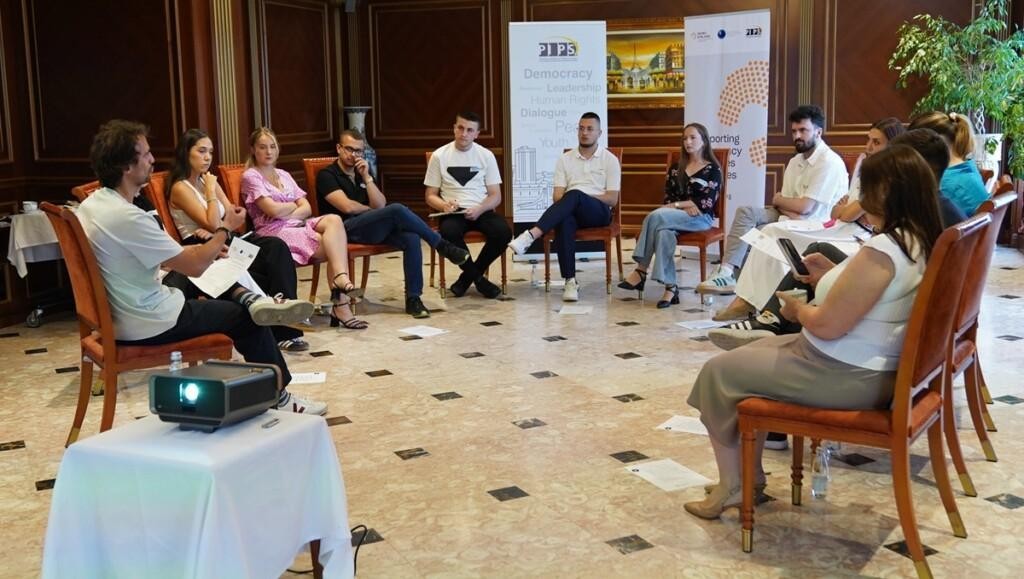
The programme aims to strengthen the political participation of young people and increase co-operation and dialogue between political parties. In the School of Politics, young political and civic actors participate in training that strengthens their skills and confidence to participate in political processes and public affairs. In addition, multi-party dialogues are organised both on the national and on the local level. The aim is to create trust and increase co-operation between political parties.
Results of our work
- A one-year pilot project was implemented in 2025. During the project, young politicians and civic actors participated in trainings of the School of Politics, which resulted in increased skills in e.g. leadership, political negotiation and communication.
- In addition, multi-party dialogues were organised for political parties’ youth wings to identify shared challenges and solutions. As a result of multi-party collaboration in the programme, youth wings of four political parties published a joint statement, calling for restraint from hate speech and disinformation in political campaigns.
Background on Kosovo
Kosovo gained independence from Serbia in 2008, although Serbia and parts of the international community still do not recognise its independence.
Although the state of democracy in Kosovo is generally good, multi-party co-operation has not been very common. In 2025 and 2026 the country has undergone multiple political crises due to the inability of political parties to collaborate and find consensus.
In the Kosovar society, ethnic divisions run deep, and this is reflected in the political arena. In particular, relations between the Albanian and Serb parties are tense. In addition, there are many minorities, including Roma, who have their own political parties.
More than half of Kosovo’s population is young. However, youth participation in political processes is low. It is hampered by political party structures in which it is difficult for young people to influence and advance, and other challenges faced by young people, such as high youth unemployment and mistrust towards young people.
- Ranked 72/179 in V-Dem’s Liberal Democracy Index.
- Classified as an electoral democracy* by V-Dem.
- Latest parliamentary election: 2025.
- Women in parliament: 33.3%.
- Kosovo is not a member of the UN and has therefore not ratified UN human rights treaties, but its constitution contains a reference to compliance with the Covenant on Civil and Political Rights and the Convention on the Rights of Women.
- More information on the state of democracy in Kosovo: https://www.idea.int/democracytracker/country/kosovo
*In electoral democracies, there are free and fair multi-party elections and satisfactory degrees of human rights and political rights, but not all the criteria of a liberal democracy are met.