
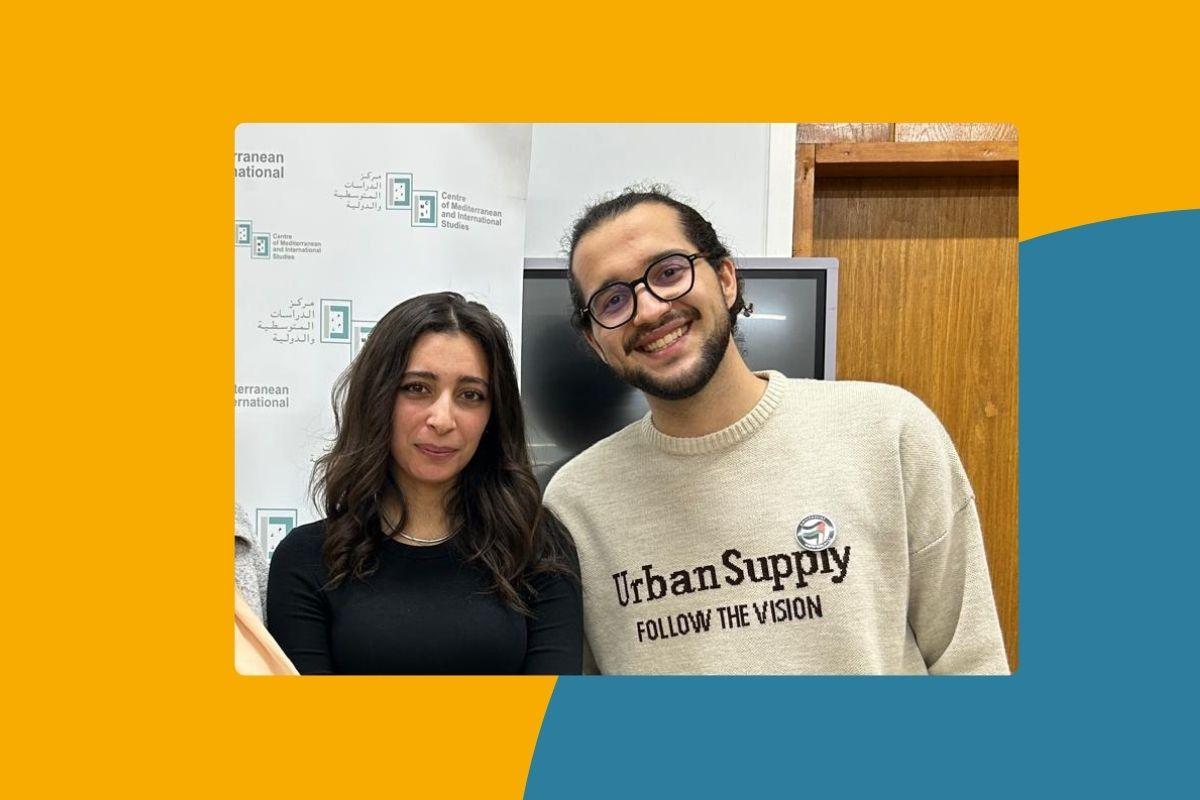
Nawres Hammedi and R.T.*, who represent different political parties, would not be friends without the Tunisian School of Politics (TSoP). TSoP provides young politicians and civil society actors with tools for engaging in politics and collaborating. For many young people, participating in TSoP trainings has been an eye-opening and life-changing experience.
- Implemented by a Tunisian think-tank Centre des Etudes Méditerranéennes et Internationales (CEMI).
- Founded in 2012 with the support of Demo Finland and the Netherlands Institute for Multiparty Democracy (NIMD).
- TSoP has trained about 1000 young people in the basics of multi-party democracy.
- Through TSoP, hundreds of politicians and civil society actors engage in dialogue each year.
- Over the years, TSoP has also organised various public events, roundtable discussions and regional seminars for young people from North Africa, the Middle East, and French-speaking Africa.
Neji Ben Abdeladhim, Nawres Hammedi and R.T. are TSoP alumni from recent years. Hammedi and R.T. come from political parties, while Ben Abdeladhim is from civil society.
Of the three, R.T. has been engaged in politics the longest. She left for the United States as an exchange student in the fall of 2010, when Tunisia was still a dictatorship ruled by President Zine El Abidine Ben Ali, but returned in 2011 to a country that had undergone a democratic revolution.
“During that year, I was introduced for the first time to what civic education is, what politics and elections mean and so on. When I came back, I wanted to experience it here: being politically active, speaking politics, having a community where I can exchange and talk about what’s going on on a bigger scale than my tiny one”, remembers R.T. “I chose Ennahda party, because I was socially conservative – I still am – and it was the most active party in the area I’m from. It also mattered that there were other young people of my age in the meetings of the party.”
More recent political developments led Nawres Hammedi to join a party. She started her political career in 2019 by running as an independent candidate in elections. “After Kais Saied’s election victory, I thought it was the moment to do something, to belong to something”, Hammedi says. In 2020, I joined the Democratic Current. I’m a social democrat, economically and socially, and it’s the only party that represents me and my thoughts.”
Neji Ben Abdeladhim, who participated in TSoP with a background in civil society, became active very young through student activism, after which he has been active, for example, in university election monitoring and human rights organisations in Tunisia. “Election monitoring was interesting and very eye-opening, but also a bit scary because I witnessed a lot of bad things”, Ben Abdeladhim explains. “So I knew that something needed to change. Until now I’m very active in social and political movements. We do protests and mock trials, because we believe that the system is not very fair.”
Difficult to mobilise young people
Tunisia is the only Arab country to have become a democracy following the 2011 uprisings. However, according to several reports assessing the state of democracy globally, the country has become more authoritarian in recent years. Saied dissolved the parliament and dismissed the government in 2021. The independence of the judiciary and electoral authorities has been significantly undermined, and the new election law excludes political parties from decision-making. In addition, several opposition politicians, civil society activists, and media representatives have been arrested on charges such as conspiracy against the state. According to democracy reports, civic space and freedom of expression have deteriorated.
It has become very difficult to mobilise youth around certain issues, particularly freedom of expression and freedom of movement.
The TSoP alumni have several priorities in their political and social activism. Hammedi has been active in advocating for the rights of prisoners, whereas for Ben Abdeladhim, the most important thing is a human rights approach, which he doesn’t see anymore in Tunisia: “The map for me is always heading towards human rights and democratic institutions.”
R.T., a doctor by profession, has focused on the digitalisation of the healthcare sector, which would help patients access care and receive the right treatment. In addition, she is interested in the intergenerational trauma caused by the era of major political upheavals and violence in Tunisia.
What they all have in common is the goal of getting young people active and the challenges they face in attempting to do so. “It has become very difficult to mobilise youth around certain issues, particularly freedom of expression and freedom of movement”, Hammedi says. “Young people especially are afraid.”
TSoP breaks down prejudices and gives tools for dialogue
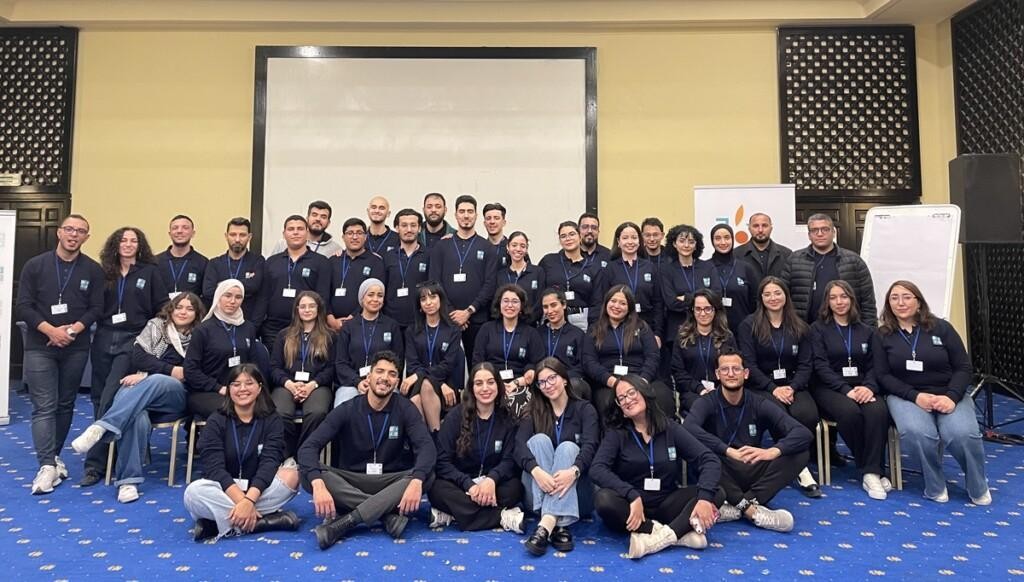
The Tunisian School of Politics organises first-level courses that last for one year, consisting of several sessions, followed by alumni courses and trainings of trainers. During the courses, participants learn about political theory and democracy, and practice political debate and collaboration.
“The amount of academic information was amazing”, Ben Abdeladhim says. “I took it very seriously. I studied well, and I had very colourful notes. Sometimes I even hosted certain lessons for the others on the bus when we were going to the training venue.”
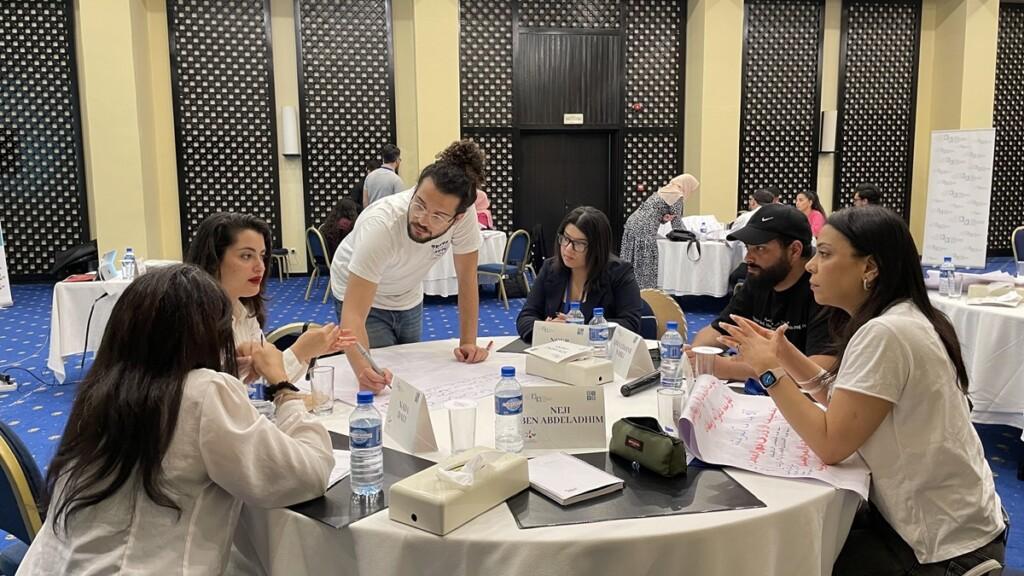
For all three of them, attending TSoP has had a transformative impact in one way or another.
According to Ben Abdeladhim, TSoP helped him find the courage to express his own opinions. R.T. describes how she had to step outside her comfort zone when she encountered people with very different opinions in the TSoP courses: “For me, it was really a game-changer. For too long, I was only exposed to like-minded people. Friends I was studying with were like me, and when I joined a political party, we all thought and talked the same way because it’s the same ideology. TSoP made me see people from another perspective.”
“Being in a diverse environment, you have to put effort and invest in these relationships to find something in common”, R.T. explains. “To find the common, you need skills. I learnt these skills from TSoP.“
She also used these skills while attending an international conference in Switzerland, where thousands of participants from around the world gathered to discuss democracy. “There were a huge number of them who actually came to a democracy forum to defend the idea that democracy is not a solution. To sit at a table with people with this large spectrum of ideas was quite interesting. Thanks to TSoP, I had the tools to navigate through these different points of view throughout the week.”
TSoP alumni can engage in discussion with people who hold different ideologies and come from different backgrounds, and they can even become friends with them.
Hammedi knows exactly what the impact of TSoP is: “R.T. and I sitting together!” She says she used to be radical and think that participants from other parties were enemies. “I then had the chance to discuss things, and I got to know them on a personal level. I’m now less radical, and I have friends who are different than me.”
All three share the experience that in the Tunisian School of Politics, they learnt that they can engage in discussion with people who hold different ideologies and come from different backgrounds, and they can even become friends with them.
Democracy is a process
The president’s actions to dissolve parliament and draft a new constitution also found support in Tunisia, as many Tunisians were frustrated with the political parties’ inability to bring about much-needed reforms and address issues such as the country’s economic problems and unemployment.
TSoP alumni do not think that the situation in Tunisia is solely due to the failure of political parties. “For sure, political parties have made mistakes, but it’s not because the parties have failed their task”, Hammedi says. “After a dictatorship, it’s normal to have even violence, and radical ideas and so on. I see that all Kais Saied did was seize the right moment.”
“All of it was new”, R.T. adds. “People went to the streets and made the revolution, but no one discussed the outcomes of the revolution. We agreed to go to the streets and to end the situation, but we didn’t actually agree on what the new system would be. That’s why it’s a process.” She emphasises that part of the process is that some parts fail and disagreements arise.
Part of the process is that some parts fail and disagreements arise.
“Democracy in Tunisia is new, it’s only a toddler”, R.T. says. “So it was really unjust and harsh to judge it.” Ben Abdeladhim continues: “We cannot blame a toddler and say, ‘Why did you put something dirty in your mouth?’ It’s supposed to do that! Democracy is supposed to do that.”
All three view Tunisia’s current situation as bleak, but they are certain that change will come eventually. R.T. points out that resilience isn’t built when everything is going well. “It is all the difficulties that are put in front of us that are going to create a very resilient generation.”
*R.T. prefers to use only her initials for this article.